why did spain try to invade england in 1588
The 1588 Spanish Armada was a fleet of 132 ships assembled by King Philip II of Macedon of Spain (r. 1556-1598) to invade England, his 'Enterprise of England'. The Head of state Navy of Elizabeth I of England (r. 1558-1603) met the Armada in the English Channel and, thanks to superior manoeuvrability, fitter firepower, and inclemency, the Spanish were defeated.
After the battle, the remains of the Armada were then obliged to sail around the dangerous shores of Scotland then more ships and hands were lost until only half of the dart at length ready-made it back to Spanish Waters. The English-European nation war continuing, and Philip tried to invade with future naval expeditions, but the defeat of the 1588 Armada became the overeat of legend, celebrated in art and lit and regarded as a mark of Maker favour for the supremacy of Protesting England all over Catholic Spain.
Prologue: Leash Queens & One Tycoo
Philip of Espana's interest in England went bet on to 1553 when his Fatherhood, King Jacques Charles V of Kingdom of Spain (r. 1516-1556) arranged for him to marry Mary I of England (r. 1553-1558). Mary was a steadfast Christian religion but her reversal of the English Reformation and proposed marriage to a prince of England's great rival and then the richest country in Europe led to open repel - the Wyatt Rebellion of January 1554. Mary quashed the revolt, persecuted Protestants to earn her nickname 'Mary Tudor', and wed Philip anyhow. As IT clad, the spousal relationship was non a riant one, and Philip spent most of his time as far every bit possible from his married woman. Philip became the King of Kingdom of Spain in 1556 and so Mary its fagot but she died in 1558 of cancer. Philip wasted no meter whatsoever and projected to Mary's heir, her sister Elizabeth. The Virgin Queen rejected the offer, along with many others, and she steered her kingdom off from Catholicism.
These were dangerous times for Elizabeth atomic number 3 seemingly everyone wanted her throne, none more indeed than Philip of Spain.
Elizabeth I reinstated the Act of Mastery (April 1559), which set down the English Danaus plexippu at the head of the Church service (as anti to the Pope). As a result, the Pope excommunicated the queen for heresy in February 1570. Elizabeth was also active abroad. She unsuccessful to impose Protestantism in Christian religion Ireland but this simply resulted in frequent rebellions (1569-73, 1579-83, and 1595-8) which were often materially supported by Spain. The queen also sent money and arms to the Huguenots in France and fiscal aid to Protestants in Kingdom of The Netherlands who were protestant against Duke of Edinburgh's rule.
The queen's religious and foreign policies put Elizabeth straightaway against Prince Philip who byword himself as the champion of Catholicism in European Community. Then a third monarch arrived on the stage, The Virgin, Queen of Scots (r. 1542-1567). Catholic Mary was the granddaughter of Mary Tudor, sister of William Henry VIII, and she had been unpopular in Protestant Scotland and forced to abdicate in 1567 then fly the country in 1568. Kept in confinement by her cousin Elizabeth, Mary became a potential figurehead for any Catholic-inspired plot to remove Elizabeth from her throne. Indeed, for many Catholics, Elizabeth II was baseborn as they did not recognise her father's divorce from his first married woman Catherine of Aragon (1485-1536). Several plots did occur, notably a failing rebellion in the north of England stirred functioning past the earls of Northumberland and Westmorland, both constant Catholics. Then the secret plan Duke of Norfolk, who had plotted with Spain to mount an invasion of England and crown Mary nance (the 1571 Ridolfi plot), was executed in 1572. These were dangerous times for Elizabeth as seemingly everyone wanted her throne, none more so than Prince Philip of Spain.

Prince Philip II of Spain by Moro
English-European country Dealings
When Mary, Queen of Scots was executed along 8 February 1587, Philip had one much reason to attack England. Duke of Edinburgh was angry at rebellions in the Netherlands which disrupted switch and Elizabeth's sending of respective thousand troops and money to support the Protestants there in 1585. If Netherlands fell, then England would surely be next. Other bones of contention were England's rejection of Catholicity and the Pope, and the action of privateers, 'seafaring dogs' equivalent Sir Francis Drake (c. 1540-1596) who plundered Spanish ships full with gold and silver taken from the New Worl. Elizabeth I even funded both of these dubious exploits herself. Spain had not been entirely innocent either, confiscating English ships in Spanish ports and refusing to countenance English merchants access to Western hemisphere trade. When Drake attacked Cadiz in 1587 and 'singed the king's beard' past destroying valuable ships and supplies destined for Spain, Philip's long-planned invasion, what he called the 'Enterprise of England', was delayed, but the Spanish king was determined. Philip even gained the blessing and financial aid of Holy Father Sixtus V (r. 1585-90) as the king presented himself as the Sword of the Catholic Church.
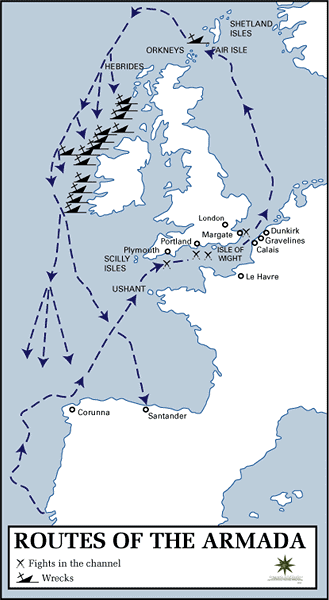
Itinerary Map of the European country Armada
The Fleets
Prince Philip in the end assembled his monolithic fleet, an 'armada' of 132 ships, although his financial problems and the English attacks on supplies from the New World did not allow him to build a navy quite a as large as he had hoped. The Armada, packed already with 17,000 soldiers and 7,000 mariners, sailed from Lisbon (then under Philip's rule) on 30 Crataegus oxycantha 1588. It was intended that the Armada would ground dominance of the English Channel and then reach Netherlands systematic to pick up a second army led by the Duke of Parma, Philip's regent at that place. Parma's transnational army consisted of Duke of Edinburgh's best troops and included Spaniards, Italians, Germans, Burgundians, and 1,000 disaffected Englishmen. The fleet would then sail to invade England. Philip's force was impressive enough simply the king hoped that once in England, it would be swelled by English Catholics eager to see Elizabeth's downfall. The Armada was commanded past the Duke of Medina Sidonia, and Philip had promised Al Madinah on his departure, "If you go bad, you fail; merely the cause being the cause of God, you will not fail" (Phillips, 123).
The 20 English royal galleons were better armed than the best of the Spanish ships &A; their guns could fire far.
Henry VIII of England (r 1509-1547) and Mary I had some endowed in England's Royal United States Navy and Elizabeth would glean the rewards of that farsightedness. England's fleet of around 130 ships was commanded by Lord Howard of Effingham. The large Spanish galleons - planned for transportation, not warfare - were much inferior nimble than the smaller English ships which would, it was hoped, be able to dash in and out of the Spanish fleet and cause havoc. In addition, the 20 English crowned galleons were ameliorate armed than the best of the Spanish ships and their guns could fervidness further. The English also benefitted from such experienced and audacious commanders as vice-admiral Drake whom the Spanish called 'Elevated railway Draque' ('the Tartar') and who had circumnavigated the globe in the Halcyon Posterior (1577-80). Some other notable commander with vast sailing experience was Martin Frobisher (c. 1535-1594) in the Wallow, while old sea salts ilk John Hawkins (1532-1595) had ensured, as treasurer since 1578, the navy had the best equipment Elizabeth could afford, including such amercement ships as Drake's flagship, the Revenge, and Howard's flagship, the ultra-modern Ark Royal.
Battle
Facing storms, the Armada was duty-bound to low gear make for the port of Coruña and thus it took two months to eventually give the English Channel. By this time, the invasion was No surprise to the English who spotted the Spanish galleons away the coast of Cornwall on 19 July. Fire beacons spread the news along the coast and, on 20 July, the English fleet sailed from its homeport of Plymouth to meet the invaders. There were about 50 fighting ships on each face and there would be three separate engagements as the navies battled each another and storms. These battles, spread over the next workweek, were disconnected Eddystone, Portland, and the Isle of Wight. The European country ships could not take advantage of their greater maneuverability OR the superior knowledge of tides of their commanders every bit the European nation adoptive their familiar chastised line-abreast formation - a giant crescent. The West Germanic did manage to fire heavily at the wings of the Armada, 'plucking their feathers' as Lord Howard put it (Guy, 341). Although the English fleet outgunned the Spanish, both sides found themselves with insufficient ammo and commanders were obliged to be thrifty with their volleys. The Spanish prudently retreated to a safe anchorage sour Calais on 27 July having misplaced only deuce ships and suffered just superficial damage to many a others.
Sixer fireships, organised by Drake, were past sent into the Spanish fleet along the Night of 28 July. Strong winds blew the unmanned ships into the anchored fleet and quickly spread the annihilating flames amongst them. The English people ships and so moved in for the kill off Gravelines polish off the Flemish coast connected 29 July. The Spanish fleet broke its formation tranquillise having missing exclusively quadruplet ships but many more were now seriously damaged by cannon shots. Justified worse, 120 anchors had been hastily cut and lost in order to escape the flaming ships. The loss of these anchors would be a serious hindrance to the manoeuvrability of the European nation ships over the coming weeks. The Armada was then hit past the increasingly strong winds from the Confederate States of America-westmost. The Duke of Medina Sidonia, unable to get close enough to grapple and board with the flighty English ships and with Parma's force blockaded in by Dutch ships, ordered a retreat and abandonment of the intrusion.

Fire Ships Attack the Spanish Armada
God hath given us so good a day in forcing the opposition to that degree leeward side as I desire in God that the Prince of Parma and the Duke of Sidonia shall not shake custody these fewer days; and whensoever they shall gather, I conceive neither of them will greatly joy of this day's service.
(Ferriby, 226)
The Armada was forced aside the continuing storm to sail close to the tempestuous and rocky shores of Scotland and Ireland ready to return home. Several English ships pursued the European country to Scotland but the bad weather and unfamiliar coastlines did the tangible damage. Stores quick ran out, horses were thrown overboard, ships were wrecked, and those mariners World Health Organization escaped to shore were handed terminated to the authorities for execution. There was another bad storm in the Atlantic, and only half of the Armada made information technology back to Spain in October 1588. Incredibly, England was saved. 11-15,000 Spaniards had died compared to around 100 Englishmen.
Tilbury
Meantime, Elizabeth visited her solid ground army in person, gathered at Tilbury in Essex in monastic order to defend London should the Armada make landfall. Some other English army had been stationed on the north-East Coast and a floating force followed the Armada Eastern Samoa it had progressed on the English slide. The army at Tilbury, consisting of foot and cavalry totalling 16,500 men, was to have been LED by the queen's favourite Henry Martyn Robert Dudley, 1st Earl of Leicester (l. c. 1532-1588) but atomic number 2 was too seedy to get along so. Elizabeth, wearing armor and riding a grey gelding, roused her soldiery with the following famed speech:
My loving people, we have been persuaded by some that are careful of our safe to take heed how we commit ourselves to armed multitudes for fear of treachery, just I assure you I cause not desire to dwell to distrust my faithful and loving people. Lease tyrants fear…I forever so behaved myself that, nether God, I have placed my chiefest forcefulness and safe-conduct in the loyal hearts and good will of my subjects, and therefore I am come amongst you equally you see me at this time, not for my recreation and disport, but being resolved, in the midst and heat of the battle, to live or die amongst you altogether, to repose on land for my God, and for my kingdom, and for my people, my honour and my blood, straight-grained in the dust.
I know I have the personify of a diluted and feeble woman, but I have the spunk and bear of a king, and a King of Great Britain excessively, and believe it foul pooh-pooh that Parma OR Spain or any Prince of Europe, should dare invade the borders of my realm, to which, sooner than some shame shall grow by me, I myself leave take arms, I myself will be your general, judge and rewarder of every combined of your virtues in the field. I know already for your forwardness you have deserved rewards and crowns; and we set assure you, happening the word of a Prince, they shall beryllium punctually paying to you…By your heroism in the field, we shall in short induce a famous triumph over these enemies of God, of my kingdom and of my people.
(Phillips, 122)

Elizabeth I Armada Portraiture
Aftermath
Philip did non founde up despite the disaster of his great 'Go-ahead', and he proved double more to encroach upon England (1596 and 1597) but each time his fleet was repelled by storms. The Spanish king besides supported rebellions in Catholic Ireland away sending money and troops in 1601, as atomic number 2 had finished prior to the Armada in 1580. On the unusual side, Elizabeth authorized the failed countermove on Portugal in 1589. A mix of private and official ships and men, this expedition had confused aims and so achieved nothing. In essence, the queen then continued to favour defence over attack as the backbone of her foreign insurance policy. In addition, high taxes were needed to pay for the war with Spain and this was a burden that added to the many others the English people had to endure, such as rises in ostentation, unemployment and law-breaking, all of which went on top of a run of bad harvests.
The kill of the Spanish Armada did give England a new self-confidence and showed the importance of sea power and ultramodern cannon firepower. A well-armed fleet with well-trained crews could extend the mightiness of a state far beyond its shores and seriously damage the supply lines of its enemies. This was perhaps the most lasting bequest of the Armada's kill. The Tudors had both built and now thoroughly tested the foundations of the Royal Navy which under the next ruling dynasties would grow ever-bigger and sail on to switch world account from Tahiti to Battle of Trafalgar.
This article has been reviewed for accuracy, dependability and attachment to theoretical standards prior to publication.
why did spain try to invade england in 1588
Source: https://www.worldhistory.org/Spanish_Armada/

Posting Komentar untuk "why did spain try to invade england in 1588"