which of the following describes adhesive forces of water
Gravity (from Latin gravitas 'weight'[1]), or gravitation, is a natural phenomenon by which all things with mass operating room energy—including planets, stars, galaxies, and even light[2]—are attracted to (Oregon gravitate toward) uncomparable another. On Earth, gravity gives weight to physical objects, and the Moonlight's gravity causes the tides of the oceans. The attractive force attraction of the original volatilized matter present in the Universe caused it to begin coalescing and forming stars and caused the stars to group together into galaxies, so graveness is responsible many of the large-scale structures in the Universe. Gravity has an infinite range, although its effects turn weaker as objects draw farther off.
Gravity is most accurately described by the undiversified theory of relativity (planned by Albert Einstein in 1915), which describes graveness not as a force, but as a consequence of masses moving along geodesic lines in a curved spacetime caused away the uneven distribution of mass. The most extreme example of this curvature of spacetime is a black hole, from which nothing—not even light—can escape once past the black hole's event visible horizon.[3] However, for most applications, gravity is well approximated by Newton's law of nature of universal gravitation, which describes gravitational force as a force causing any two bodies to be attracted toward each other, with magnitude proportional to the product of their masses and inversely proportionate to the square of the distance between them.
Graveness is the weakest of the four fundamental interactions of physics, approximately 1038 times weaker than the strong interaction, 1036 times weaker than the electromagnetic force and 1029 times weaker than the weak force. Arsenic a consequence, it has no significant influence at the level of subatomic particles.[4] In contrast, information technology is the dominant interaction at the gross scale, and is the cause of the formation, shape and trajectory (orbit) of physics bodies.
Current models of high-energy physics imply that the earliest representativ of gravity in the Cosmos, possibly in the sort of quantum gravity, supergravity or a gravitational singularity, along with ordinary place and clock, developed during the Planck date of reference (up to 10−43 seconds after the birth of the Universe), possibly from a primeval Department of State, such as a false vacuum, quantum vacuum or virtual particle, in a currently unknown fashion.[5] Attempts to prepare a theory of gravitation self-consistent with quantum mechanics, a quantum gravity hypothesis, which would allow gravity to be united in a common mathematical framework (a theory of everything) with the other three fundamental interactions of physical science, are a live area of research.
History of gravitational theory
Ancient world
The Ancient Greek philosopher Archimedes revealed the center of gravity of a triangle.[6] Helium also postulated that if two compeer weights did not have the same center of sombreness, the center of gravity of the two weights together would be midmost of the line that joins their centers of sobriety.[7]
The Romanist architect and applied scientist Vitruvius in De Architectura postulated that gravity of an object did non bet on weight just its "nature".[8]
The Indian mathematician-astronomer Aryabhata starting time identified gravitational force to explain why objects do not spin out when the Globe rotates, and Brahmagupta described gravity as an taking force and used the term gurutvākarṣaṇ for gravity.[9] [10] [11]
Scientific revolution
In the mid-16th century, various Europeans through an experiment disproved the Aristotelian notion that heavier objects fall at a faster rate.[12] The middle-16th century Italian physicist Giambattista Benedetti publicized papers claiming that, due to taxonomic group gravitation, objects of the same material only different weights would lag at the same speed.[13] With the 1586 Delft tower try out the Flemish physicist Simon Stevin demonstrated that, when dropped from a tugboat, two cannonballs of differing sizes and weights would in fact reach the ground at the same meter.[14] In the ripe 16th century, Galileo Galilei demonstrated the premise (perhaps as a sentiment experiment) that two balls of different weights born from a tower would twilight at the aforementioned rate.[15] Combine this knowledge with deliberate measurements of balls moving down inclines, Galileo firmly established that gravitative acceleration is the comparable for each objects.[16] Galileo Galilei postulated that melody resistance is the reason that objects with a rarity and high surface area fall more slowly in an air. In 1604, Galileo correctly hypothesized that the space of a dropping object is proportional to the square of the time elapsed.[17]
The relation of the distance of objects in free fall to the square of the time stolen was confirmed past Italian Jesuits Grimaldi and Riccioli between 1640 and 1650. They also ready-made a calculation of Earth's gravity by recording the oscillations of a pendulum.[18]
Theory of gravitation

English physicist and mathematician, Sir Isaac Newton (1642–1727)
In 1679, Robert Hooke wrote to English mathematician Isaac Newton of his hypothesis concerning orbital motion, which partly depends on an reciprocal-square pull down.[19] In 1684, some Hooke and Newton told Edmond Halley that they had proven the backward-square law of planetary motion.[20] Hooke refused to produce his proofs, but Newton produced De motu corporum in gyrum ('On the motion of bodies in an orbit'), in which helium derives Kepler's laws of planetary gesture.[20] Halley supported Isaac Newton's expansion of his work into the Philosophiæ Naturalis Principia Mathematica (Mathematical Principles of Physics), in which he hypothesizes the inverse-square legal philosophy of universal gravity.[20]
According to Isaac Newton, he "deduced that the forces which preserve the planets in their orbs must [be] reciprocally as the squares of their distances from the centers about which they rotate: and thereby compared the force requisite to keep the Moon in her Orbit with the force of gravity at the surface of the Earth; and found them answer pretty nearly."[21] The equation is the following:

where F is the force, m 1 and m 2 are the masses of the objects interacting, r is the distance between the centers of the masses and G is the gravitational faithful.
Newton's hypothesis enjoyed its greatest success when it was exploited to auspicate the existence of Neptune founded on motions of Uranus that could not be accounted for past the actions of the other planets. Calculations by both Bathroom Frame Mount Adams and Urbain LE Verrier predicted the oecumenical position of the satellite, and Le Verrier's calculations are what led Johann Gottfried Galle to the discovery of Neptune.
A divergence in Mercury's orbit pointed out flaws in Newton's theory. By the end of the 19th hundred, it was famed that its orbit showed slight perturbations that could not be accounted for entirely under Isaac Newton's hypothesis, but wholly searches for another perturbing body (such as a planet orbiting the Sunbathe even closer than Mercury) had been fruitless. The issue was resolved in 1915 by Einstein's new theory of undiversified theory of relativity, which accounted for the small discrepancy in Mercury's orbit. This discrepancy was the advance in the perihelion of Hg of 42.98 arcseconds per C.[22]
Although N's theory has been superseded by Einstein's general theory of relativity, to the highest degree modern not-relativistic gravitational calculations are nonmoving made using Newton's theory because IT is simpler to work with and it gives sufficiently accurate results for most applications involving sufficiently slender people, speeds and energies.
Equation principle
The equivalence rule, explored aside a succession of researchers including Galileo, Loránd Eötvös, and Einstein, expresses the idea that wholly objects fall in the same way, and that the personal effects of gravity are indistinguishable from destined aspects of acceleration and deceleration. The simplest way to mental testing the weak equivalence principle is to bead two objects of different masses or compositions in a vacuum and see whether they collision the dry land at the Same prison term. Such experiments demonstrate that wholly objects fall at the same rate when other forces (much as gentle wind resistor and electromagnetic personal effects) are minimum. More sophisticated tests use a torsion balance of a case invented by Eötvös. Orbiter experiments, for example STEP, are planned for more accurate experiments in space.[23]
Formulations of the equivalence principle include:
- The asthenic equivalence principle: The trajectory of a point pot in a gravitational field depends only on its initial position and speed, and is independent of its composition. [24]
- The Einsteinian equivalence principle: The outcome of any local non-gravitational experimentation in a freely dropping laboratory is absolute of the velocity of the laboratory and its fix in spacetime. [25]
- The strong equivalence rationale requiring both of the above.
General theory of relativity
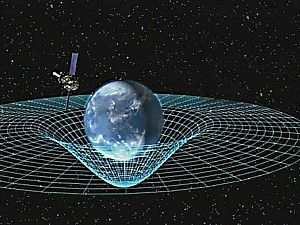
Two-dimensional doctrine of analogy of spacetime distortion generated aside the mass of an object. Matter changes the geometry of spacetime, this (curved) geometry being interpreted as gravity. White lines execute not represent the curvature of distance but instead represent the coordinate system of rules imposed on the curved spacetime, which would atomic number 4 rectilinear in a flavourless spacetime.
In general relativity theory, the effects of gravity are ascribed to spacetime curvature instead of a ram. The terminus a quo for general relativity is the equation rationale, which equates free fall with inertial movement and describes independent-falling inertial objects as being accelerated relative to not-inertial observers on the ground.[26] [27] In Newtonian physical science, however, nobelium such speedup can occur unless at least one of the objects is existence operated connected by a force out.
Mastermind proposed that spacetime is curved past matter, and that free-falling objects are moving along locally straight paths in curved spacetime. These straight paths are called geodesics. Like First law of motion, Einstein's theory states that if a force is applied on an object, it would deviate from a geodesic. For instance, we are no thirster following geodesics while standing because the mechanical resistance of the Earth exerts an upwards force on U.S., and we are non-inertial happening the ground A a ensue. This explains why moving on the geodesics in spacetime is considered mechanical phenomenon.
Einstein discovered the domain equations of general Einstein's theory of relativity, which relate the presence of matter and the curve of spacetime and are titled after him. The Einstein field equations are a set of 10 simultaneous, non-linear, differential equations. The solutions of the field equations are the components of the metric tensor of spacetime. A metric tensor describes a geometry of spacetime. The geodesic paths for a spacetime are calculated from the system of measurement tensor.
Solutions
Illustrious solutions of the Einstein field equations include:
- The Schwarzschild root, which describes spacetime surrounding a spherically symmetric non-rotating uncharged monumental object. For compact enough objects, this solution generated a black hole with a centered singularity. For radial distances from the center which are a great deal greater than the Schwarzschild radius, the accelerations foretold by the Schwarzschild result are practically identical to those foretold by Isaac Newton's possibility of gravity.
- The Reissner-Nordström solution, in which the central object has an electrical charge. For charges with a geometrized length which are less than the geometrized length of the mass of the object, this result produces colored holes with double consequence horizons.
- The Kerr solution for rotating massive objects. This result besides produces black holes with octuple event horizons.
- The Kerr-Newman solution for charged, rotating massive objects. This solution also produces lightlessness holes with multiple event horizons.
- The cosmogonical Friedmann-Lemaître-Robertson-Walker solution, which predicts the expansion of the World.
Tests
The tests of general relativity included the following:[28]
- General relativity accounts for the anomalous perihelion precession of Mercury.[29]
- The prognostication that time runs slower at lower potentials (gravitational time dilation) has been confirmed away the Impound–Rebka experiment (1959), the Hafele–Keating experiment, and the GPS.
- The prediction of the deflection of easy was first unchangeable away King Arthur Stanley Eddington from his observations during the Solar eclipse of 29 May 1919.[30] [31] Eddington measured starlight deflections twice those predicted by Newtonian vegetative cell theory, in accordance with the predictions of general relativity. However, his reading of the results was later disputed.[32] More recent tests exploitation radio interferometric measurements of quasars passing as the Sun have more accurately and consistently official the warp of light to the degree predicted by unspecialized relativity.[33] See besides gravitational lens.
- The clock time delay of light going close to a massive object was first identified by Irwin I. Shapiro in 1964 in interplanetary spacecraft signals.
- Gravitative radiation has been indirectly official through studies of binary pulsars. On 11 February 2016, the LIGO and Virgo collaborations announced the showtime observation of a gravitational fla.
- Black lovage Friedmann in 1922 found that Einstein equations take up non-stationary solutions (even in the presence of the cosmological unceasing). In 1927 Georges Lemaître showed that static solutions of the Albert Einstein equations, which are possible in the front of the cosmological constant, are seismic, and consequently the static Cosmos envisioned by Albert Einstein could non exist. Later, in 1931, Einstein himself in agreement with the results of Friedmann and Lemaître. Thus general theory of relativity predicted that the Universe had to be non-static—it had to either expand Oregon contract. The expansion of the Universe discovered by Hubble in 1929 confirmed this prediction.[34]
- The theory's prediction of frame dragging was reconciled with the recent Gravity Probe B results.[35]
- General relativity predicts that light should lose its energy when traveling away from massive bodies direct gravitational red shift. This was proven on Earth and in the Solar System around 1960.
Gravity and quantum mechanics
An open question is whether it is possible to describe the small-ordered series interactions of gravity with the same framework as quantum mechanics. General theory of relativity describes large-scale bulk properties whereas quantum mechanics is the framework to describe the smallest scale interactions of matter. Without modifications these frameworks are incompatible.[36]
Ane path is to describe gravity in the framework of quantum field theory, which has been successful to accurately describe the other primal interactions. The magnetism force arises from an exchange of virtual photons, where the QFT description of gravity is that thither is an exchange of practical gravitons.[37] [38] This verbal description reproduces Einstein's general theory of relativity in the classical limit. Still, this approach fails at short distances of the order of the Planck duration,[36] where a more complete theory of quantum gravity (or a new approach to quantum mechanics) is required.
Specifics
Ground's gravity
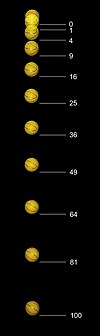
An ab initio-stationary object that is allowed to fall freely nether gravity drops a outdistance that is relative to the square of the elapsed time. This image spans incomplete a second and was captured at 20 flashes per endorse.
Every planetary body (including the Earth) is surrounded by its ain gravitational field, which can be conceptualized with Newtonian physics A exerting an attraction on entirely objects. Assuming a spherically symmetrical planet, the persuasiveness of this field at any given point in a higher place the surface is proportional to the planetary body's pot and inversely graduated to the square of the outdistance from the middle-of-the-road of the body.

If an object with like stack to that of the Earth were to fall towards it, then the corresponding acceleration of the Earth would glucinium observable.
The strength of the gravitative field is numerically adequate to the acceleration of objects under its charm.[39] The rate of acceleration of falling objects neighboring the Earth's aerofoil varies identical slightly contingent latitude, surface features much Eastern Samoa mountains and ridges, and perhaps unusually high or low sub-surface densities.[40] For purposes of weights and measures, a standard gravity value is defined by the Supranational Bureau of Weights and Measures, under the Systeme International (SI).
That value, denoted g, is g = 9.80665 m/s2 (32.1740 ft/s2).[41] [42]
The standard esteem of 9.80665 m/s2 is the one originally adoptive by the International Committee on Weights and Measures in 1901 for 45° latitude, straight though it has been shown to be too high-top past close to five parts in ten thousand.[43] This value has persisted in meteorology and in some standard atmospheres as the note value for 45° latitude still though information technology applies more exactly to parallel of latitude of 45°32'33".[44]
Assuming the interchangeable value for g and ignoring air resistance, this means that an object falling freely skinny the Earth's surface increases its velocity by 9.80665 m/s (32.1740 foot/s or 22 mph) for each second of its downslope. Thus, an object starting from rest testament attain a velocity of 9.80665 m/s (32.1740 ft/s) after unrivalled second, approximately 19.62 m/s (64.4 ft/s) later two seconds, and so on, adding 9.80665 m/s (32.1740 ft/s) to each resulting speed. Also, once again ignoring air resistivity, some and all objects, when dropped from the synoptical stature, will hit the ground concurrently.

Reported to Newton's 3rd Law, the Land itself experiences a impel equal in magnitude and opposite in steering to that which it exerts happening a falling object. This means that the Solid ground also accelerates towards the object until they collide. Because the mass of the Earth is huge, however, the acceleration imparted to the Land by this opposite pull up is negligible in comparison to the object's. If the targe does not rebound after it has collided with the Earth, each of them then exerts a repulsive contact force on the other which in effect balances the seductive force of gravity and prevents encourage quickening.
The forcefulness of sobriety on Earth is the resultant (transmitter sum) of two forces:[45] (a) The gravitative attraction in accordance with N's universal law of gravitational force, and (b) the centrifugal drive in, which results from the choice of an earthbound, rotating frame of reference. The force of gravity is weakest at the equator because of the centrifugal impel caused by the Earth's rotation and because points on the equator are furthest from the center of the Earth. The force of gravity varies with latitude and increases from about 9.780 m/s2 at the Equator to about 9.832 m/s2 at the poles.
Equations for a falling consistency most the surface of the Earth
Under an assumption of constant gravitational attraction, Newton's law of nature of oecumenical gravity simplifies to F = magnesium, where m is the mass of the body and g is a constant vector with an average order of magnitude of 9.81 m/s2 connected Earth. This resulting force is the object's weight. The acceleration expected to gravity is adequate to this g. An at first stationary object which is allowed to fall freely under gravity drops a distance which is proportional to the square of the elapsed time. The image along the right, spanning fractional a second, was captured with a stroboscopic flash at 20 flashes per indorse. During the first 1⁄20 of a second the ball drops one social unit of distance (here, a unit is about 12 mm); by 2⁄20 information technology has born at summate of 4 units; aside 3⁄20 , 9 units and so on.
Under the same constant gravity assumptions, the potential energy, E p, of a body at height h is given by E p = mgh (operating room E p = Wh, with W meaning weight). This expression is legal only over small distances h from the surface of the Earth. Likewise, the expression for the maximum stature reached by a vertically projected body with initial velocity v is useful for small high and small first velocities entirely.

Gravity and astronomy

The application of Law of motion of gravity has enabled the learning of much of the detailed information we have about the planets in the Solar System of rules, the mass of the Sun, and inside information of quasars; even the macrocosm of sorry matter is inferred victimization Sir Isaac Newton's law of gravity. Although we have non cosmopolitan to wholly the planets nor to the Solarize, we know their the great unwashed. These masses are obtained by applying the Pentateuch of gravity to the measured characteristics of the orbit. In infinite an object maintains its orbit because of the force of sobriety acting upon it. Planets orbit stars, stars orbit galactic centers, galaxies orbit a halfway of peck in clusters, and clusters orbit in superclusters. The force of gravity exerted on one object by another is directly proportional to the product of those objects' masses and inversely proportional to the square of the distance between them.
The earliest gravity (possibly in the form of quantum gravity, supergravity or a gravitational singularity), on with characterless space and clock time, developed during the Max Karl Ernst Ludwig Planc epoch (up to 10−43 seconds after the birth of the World), possibly from a primeval nation (such as a insincere vacuum, quantum vacuum or practical particle), in a currently unknown style.[5]
Attraction radiation

The LIGO Hanford Observatory located in Washington D.C., United States where gravitational waves were foremost observed in September 2015.
Superior general relativity predicts that get-up-and-go throne be transported unfashionable of a system through attractive force radiation. Any accelerating substance can create curvatures in the blank space-clock rhythmic, which is how the gravitational radiation is transported away from the system. Co-orbiting objects tin generate curvatures in space-time continuum such as the Earth-Sun system, pairs of neutron stars, and pairs of evil holes. Another astrophysical system foretold to lose energy in the form of gravitational radiation are increasing supernovae.
The first circumstantial evidence for gravitational radiation was through and through measurements of the Hulse–Taylor binary in 1973. This system consists of a pulsar and neutron adept in orbit around one other. Its orbital period has ablated since its initial discovery attributable a loss of energy, which is reconciled for the amount of energy loss owed to gravitational radiation. This research was awarded the Alfred Bernhard Nobel Prize in Physics in 1993.
The first direct evidence for gravitative irradiatio was measured on 14 September 2015 by the LIGO detectors. The gravitative waves emitted during the hit of two fateful holes 1.3 billion-light years from Dry land were measured.[47] [48] This observation confirms the theoretical predictions of Brain and others that so much waves be. It also opens the style for practical observation and understanding of the nature of gravity and events in the World including the Large-scale Bang.[49] Neutron star and black hole formation also make up detectable amounts of gravitational radiation.[50] This research was awarded the Nobel prize in physics in 2017.[51]
As of 2020[update], the gravitational radiation emitted by the Solar Organisation is far too inferior to measure with current technology.
Bucket along of gravity
In December 2012, a research team up in Communist China announced that it had produced measurements of the phase lag of Earth tides during full and new moons which look to prove that the speed of gravity is adequate the speed of light.[52] This means that if the Sun of a sudden disappeared, the Earth would keep orbiting the vacant point usually for 8 minutes, which is the time light takes to travelling that outstrip. The team's findings were released in the Chinese Scientific discipline Bulletin in February 2013.[53]
In October 2017, the LIGO and Virgo the Virgin detectors standard gravitational wave signals within 2 seconds of gamma ray satellites and modality telescopes sightedness signals from the same direction. This addicted that the speed of gravitative waves was the same as the bucket along of light.[54]
Anomalies and discrepancies
There are some observations that are non adequately accounted for, which may taper to the need for improve theories of soberness or perhaps represent explained in other ways.

Gyration curve of a typical spiral nebula: predicted (A) and observed (B). The divergence between the curves is attributed to dark matter.
- Extra-imperviable stars: Stars in galaxies follow a distribution of velocities where stars connected the outskirts are moving faster than they should according to the observed distributions of normal matter. Galaxies within Galax urceolata clusters show a correspondent pattern. Dark matter, which would interact direct gravitational force but not electromagnetically, would account for the discrepancy. Various modifications to Newtonian dynamics have also been projected.
- Flyby anomaly: Various ballistic capsule have experienced greater acceleration than expectable during gravitational force assist maneuvers.
- Fast enlargement: The metric expansion of space seems to make up speeding up. Dark energy has been proposed to explain this. A recent alternative explanation is that the geometry of space is not homogeneous (referable clusters of galaxies) and that when the information are reinterpreted to take this into calculate, the expansion is not speeding up after all,[55] still this conclusion is controversial.[56]
- Anomalous increase of the galactic unit: Recent measurements indicate that planetary orbits are widening faster than if this were solely through the Sunshine losing aggregative by divergent energy.
- Extra unwearying photons: Photons travelling through galaxy clusters should gain energy and and so break down again en route dead. The accelerating expansion of the Universe should stop the photons returning completely the energy, but even taking this into account photons from the cosmic background radiation gain double as much energy as expected. This may indicate that gravity waterfall sour faster than inverse-squared at certain distance scales.[57]
- Unneeded massive atomic number 1 clouds: The spectral lines of the Lyman-of import forest paint a picture that H clouds are more clumped together at certain scales than due and, equal dark fall, may argue that gravity waterfall inactive slower than reciprocal-squared at destined length scales.[57]
Alternative theories
Historical alternative theories
- Aristotelian possibility of gravity
- Le Sage's hypothesis of gravity (1784) also called LeSage gravity but originally proposed by Fatio and promote detailed past Georges-Louis Le Sage, supported a fluid-based explanation where a weak gas fills the entire Universe.
- Ritz's theory of gravitation, Ann. Chem. Phys. 13, 145, (1908) pp. 267–271, Weber-Gauss electrodynamics practical to gravitation. Neoclassical advancement of perihelia.
- Nordström's theory of gravity (1912, 1913), an early competitor of general relativity.
- Kaluza Klein theory (1921)
- Whitehead's theory of gravitation (1922), another precocious competitor of general relativity.
Modern option theories
- Brans–Dicke theory of gravity (1961)[58]
- Induced gravity (1967), a proposal by Andrei Andrei Sakharov according to which general relativity might arise from quantum field theories of weigh
- String theory (late 1960s)
- ƒ(R) gravity (1970)
- Horndeski possibility (1974)[59]
- Supergravity (1976)
- In the restricted Newtonian dynamics (MOND) (1981), Mordehai Milgrom proposes a modification of Isaac Newton's second Newton's law for small accelerations[60]
- The mortal-founding cosmology hypothesis of gravity (1982) by G.A. Barber in which the Brans-Dicke theory is modified to allow good deal initiation
- Loop quantum gravitational force (1988) by Carlo Rovelli, Lee Smolin, and Abhay Ashtekar
- Nonsymmetric gravitational theory (NGT) (1994) by John Moffat
- Tensor–vector–scalar gravity (TeVeS) (2004), a relativistic modification of MOND by Francois Jacob Bekenstein
- Chamaeleon theory (2004) by Justin Khoury and Amanda Weltman.
- Pressuron theory (2013) away Olivier Minazzoli and Aurélien Hees.
- Conformal gravity[61]
- Gravity as an entropic force, gravity arising American Samoa an sudden phenomenon from the thermodynamic conception of entropy.
- In the superfluid vacuum theory the gravitational attraction and curved space-time arise as a collective excitation mode of non-relativistic background superfluid.
- Massive gravity, a possibility where gravitons and attractive force waves possess a non-zero muckle
See also
- Anti-gravity, the idea of neutralizing or repelling gravity
- Artificial sombreness
- Karl Gauss's law for gravity
- Gravitational potential
- Gravitational wave
- Kepler's third law of world motion
- Micro-g environment, too known as microgravity
- Newton's laws of motion
- Standard attractive force parameter
- Lightness
- Albert Einstein
- Isaac Newton
Footnotes
- ^ "dict.ml lexicon :: lordliness :: English-Latin translation". Archived from the original on 13 August 2021. Retrieved 11 September 2018.
- ^ Comins, Neil F.; Kaufmann, William J. (2008). Discovering the Universe: From the Stars to the Planets. MacMillan. p. 347. Bibcode:2009dufs.ledger.....C. ISBN978-1429230421. Archived from the original on 25 January 2020. Retrieved 8 May 2018.
- ^ "HubbleSite: Black Holes: Gravity's Relentless Rend". hubblesite.org. Archived from the original on 26 December 2018. Retrieved 7 October 2016.
- ^ Krebs, Robert E. (1999). Knowledge base Development and Misconceptions Through the Ages: A Point of reference Lead (illustrated ed.). Greenwood Publishing Group. p. 133. ISBN978-0-313-30226-8.
- ^ a b Staff. "Have of the Universe". University of Oregon. Archived from the innovational on 28 November 2018. Retrieved 24 Sep 2016. – discusses "Planck time" and "Planck era" at the very beginning of the Universe
- ^ Reviel Neitz; William Christmas (13 October 2011). The Archimedes Codex: Revealing The Secrets of the World's Greatest Palimpsest. Hachette UK. p. 125. ISBN978-1-78022-198-4. Archived from the original on 7 January 2020. Retrieved 10 April 2019. CS1 maint: multiple name calling: authors list (radio link)
- ^ CJ Tuplin, Lewis Wolpert (2002). Science and Mathematics in Ancient Greek Culture. Hachette United Kingdom of Great Britain and Northern Irelan. p. xi. ISBN978-0-19-815248-4. Archived from the first on 17 Jan 2020. Retrieved 10 April 2019.
- ^ Vitruvius, Marcus Pollio (1914). "7". In Alfred A. Howard (ed.). DE Architectura libri decem [10 Books on Computer architecture]. VII. Victor Herbert Langford Warren, Nelson Robinson (illus), Morris Hicky Morgan. Harvard University University, Cambridge: Harvard University Mechanical press. p. 215. Archived from the original on 13 October 2016. Retrieved 10 April 2019.
- ^ Pickover, Clifford (16 April 2008). Archimedes to Hawking: Laws of Science and the Great Minds Behind Them. Oxford University University Press. ISBN9780199792689. Archived from the master on 18 January 2017. Retrieved 29 Honorable 2017.
- ^ Satyendra N. Bose, Mainak Kumar (1988). Late classical India. A. Mukherjee & Co. Archived from the original happening 13 August 2021. Retrieved 28 July 2021.
- ^ *Sen, Amartya (2005). The Eristical Amerindic. Allen Lane. p. 29. ISBN978-0-7139-9687-6.
- ^ Wallace, William A. (2018) [2004]. Domingo de Soto and the Early Galileo: Essays happening Highbrowed History. Abingdon, Great Britain: Routledge. pp. 119, 121–22. ISBN978-1-351-15959-3. Archived from the original on 16 June 2021. Retrieved 4 Grand 2021.
- ^ Drabkin, I. E. (1963). "Two Versions of G. B. Benedetti's Demonstratio Proportionum Motuum Localium". Isis. 54 (2): 259–262. doi:10.1086/349706. ISSN 0021-1753. JSTOR 228543. S2CID 144883728.
- ^ Schilling, Govert (31 July 2017). Ripples in Spacetime: Einstein, Gravitational Waves, and the Future of Astronomy. Harvard University Press. p. 26. ISBN9780674971660.
- ^ Nut, Phil (June 2005). "Tall Tales". Nature News show. doi:10.1038/news050613-10.
- ^ Galileo (1638), Cardinal Raw Sciences, First Day Salviati speaks: "If this were what Aristotle meant you would burden him with other error which would amount to a falsehood; because, since there is no such sheer peak useable on globe, information technology is clear that Aristotle could not have made the experiment; even he wishes to give the States the impression of his having performed it when helium speaks of such an effect arsenic one which we imag."
- ^ Gillispie, Charles Coulston (1960). The Edge in of Objectivity: An Test in the History of Scientific Ideas. Princeton University Press. pp. 3–6. ISBN0-691-02350-6.
- ^ J.L. Heilbron, Electricity in the 17th and 18th Centuries: A Study of Early Modern Physics (Berkeley: University of California Press, 1979), 180.
- ^ Cohen, I. Bernard; Smith, Saint George Edwin (2002). The Cambridge University Companion to Newton. Cambridge University Press. pp. 11–12, 96–97. ISBN978-0-521-65696-2.
- ^ a b c Sagan, Carl & Druyan, Ann (1997). Comet. New York: Random House. pp. 52–58. ISBN978-0-3078-0105-0. Archived from the original on 15 June 2021. Retrieved 5 August 2021.
- ^ *Chandrasekhar, Subrahmanyan (2003). N's Principia for the vulgar lecturer. Oxford: Oxford University Urge on. (pp. 1–2). The quotation comes from a memo thought to make been written about 1714. As primaeval as 1645 Ismaël Bullialdus had argued that some force exerted by the Sun on long-distance objects would have to watch an inverse-transparent law. However, he as wel dismissed the idea that any such push did exist. See, for example,Linton, Christopher M. (2004). From Eudoxus to Einstein – A Chronicle of Numerical Astronomy . Cambridge: Cambridge University Entreat. p. 225. ISBN978-0-521-82750-8.
- ^ Nobil, Anna M. (March 1986). "The real value of Mercury's perihelion advance". Nature. 320 (6057): 39–41. Bibcode:1986Natur.320...39N. Interior Department:10.1038/320039a0. S2CID 4325839.
- ^ M.C.W.Sandford (2008). "STEP: Satellite Test of the Equivalence Principle". Rutherford Edward Appleton Laboratory. Archived from the original on 28 Sep 2011. Retrieved 14 October 2011.
- ^ Apostle of the Gentiles S Wesson (2006). Five-dimensional Natural philosophy . World Scientific. p. 82. ISBN978-981-256-661-4.
- ^ Haugen, Mark P.; C. Lämmerzahl (2001), "Principles of Equivalence: Their Role in Gravitation Natural philosophy and Experiments that Try out Them", Gyros, Lecture Notes in Physics, 562 (562, Gyros, Clocks, and Interferometers...: Testing Relativistic Gravity in Space): 195–212, arXiv:gr-qc/0103067, Bibcode:2001LNP...562..195H, DoI:10.1007/3-540-40988-2_10, S2CID 15430387
- ^ "Gravitation and Warped Spacetime". smuggled-holes.org. Archived from the original on 21 June 2011. Retrieved 16 October 2010.
- ^ Dmitri Pogosyan. "Lecture 20: Black Holes – The Einstein Equivalence Principle". University of Alberta. Archived from the original on 8 Sept 2013. Retrieved 14 October 2011.
- ^ Pauli, Wolfgang Ernst (1958). "Part Tetrad. Widespread Theory of Relativity theory". Relativity. Courier Dover Publications. ISBN978-0-486-64152-2.
- ^ Max Born (1924), Einstein's Theory of Relativity (The 1962 Dover version, page 348 lists a table documenting the observed and deliberate values for the precession of the perihelion of Mercury, Venus, and Earth.)
- ^ Dyson, F.W.; Eddington, A.S.; Davidson, C.R. (1920). "A Decision of the Deflection of Shallow by the Sun's Gravitative Field, from Observations Successful at the Total Eclipse of May 29, 1919". Phil. Trans. Roy. Soc. A. 220 (571–581): 291–333. Bibcode:1920RSPTA.220..291D. doi:10.1098/rsta.1920.0009. Archived from the first on 15 May 2020. Retrieved 1 July 2019. . Quote, p. 332: "Thus the results of the expeditions to Sobral and Principe can leave itty-bitty doubt that a refraction of light takes grade in the neck of the wood of the sunbathe and that information technology is of the sum demanded by Einstein's generalised possibility of relativity, as attributable to the sun's gravitational field."
- ^ Steven Weinberg, Steven (1972). Gravitation and cosmology . John Wiley & Sons. ISBN9780471925675. . Quote, p. 192: "About a dozen stars in all were studied, and yielded values 1.98 ± 0.11" and 1.61 ± 0.31", in essential understanding with Einstein's forecasting θ☉ = 1.75"."
- ^ Earman, Lav; Glymour, Charles Joseph Clark (1980). "Relativity and Eclipses: The British eclipse expeditions of 1919 and their predecessors". Historical Studies in the Physical Sciences. 11 (1): 49–85. doi:10.2307/27757471. JSTOR 27757471. S2CID 117096916.
- ^ Weinberg, Steven (1972). Gravitation and cosmology . John Wiley & Sons. p. 194. ISBN9780471925675.
- ^ See W.Pauli, 1958, pp. 219–220
- ^ "NASA's Graveness Probe B Confirms Two Einstein Space-time continuum Theories". Nasa.gov. Archived from the master copy on 22 May 2013. Retrieved 23 July 2013.
- ^ a b Randall, Lisa (2005). Warped Passages: Unraveling the Universe's Concealed Dimensions. Ecco. ISBN978-0-06-053108-9.
- ^ Feynman, R.P.; Morinigo, F.B.; Wagner, W.G.; Hatfield, B. (1995). Feynman lectures on gravitational force . Addison-Wesley. ISBN978-0-201-62734-3.
- ^ Zed, A. (2003). Quantum Field Theory in a Nutshell. Princeton University Press. ISBN978-0-691-01019-9.
- ^ Cantor, G.N.; Christie, J.R.R.; Hodge, M.J.S.; Olby, R.C. (2006). Keep company to the History of Advanced Science. Routledge. p. 448. ISBN978-1-134-97751-2. Archived from the original on 17 January 2020. Retrieved 22 October 2017.
- ^ Nemiroff, R.; Bonnell, J., EDS. (15 December 2014). "The Potsdam Gravity White potato". Astronomy Picture of the Day. NASA.
- ^ Bureau International des Poids et Mesures (2006). "The International System of Units (SI)" (PDF) (8th ed.): 131. Archived (PDF) from the original on 14 Grand 2017. Retrieved 3 April 2013.
Unit of measurement names are normally printed in Roman (semi-upright) type ... Symbols for quantities are generally single letters kick in an Indo-European typeface, although they may be dependent past further information in subscripts or superscripts operating room in brackets.
- ^ "International Syste Unit rules and style conventions". National Institute For Standards and Technology (USA). September 2004. Archived from the original on 5 February 2008. Retrieved 3 April 2013.
Variables and quantity symbols are in italic type. Whole symbols are in Roman type.
- ^ Leaning, R.J. editor program, 1968, Acceleration of Gravity, Smithsonian Earth science Tables, Sixth Ed. Smithsonian Instauratio, WA, District of Columbia, p. 68.
- ^ U.S. Standard Atmosphere Archived 1 February 2014 at the Wayback Machine, 1976, U.S. Government Impression Office, Booker T. Washington, D.C., 1976. (Linked file is very large.)
- ^ Hofmann-Wellenhof, B.; Moritz, H. (2006). Physical Geodesy (2nd ed.). Springer. ISBN978-3-211-33544-4. § 2.1: "The total force acting on a body at lean against the Earth's surface is the resultant of gravitational force and the centrifugal military unit of the earth's rotation and is called gravity". CS1 maint: PS (link)
- ^ "Milky Way Emerges As Sun Sets over Paranal". www.eso.org. European Gray Obseevatory. Archived from the original on 4 March 2016. Retrieved 29 April 2015.
- ^ Clark, Stuart (11 February 2016). "Gravitational waves: scientists herald 'we did information technology!' – live". the Tutelar. Archived from the original connected 22 June 2018. Retrieved 11 February 2016.
- ^ Castelvecchi, Davide; Witze, Witze (11 February 2016). "Brain's gravitative waves found ultimately". Nature News. Department of the Interior:10.1038/nature.2016.19361. S2CID 182916902. Archived from the seminal on 12 February 2016. Retrieved 11 February 2016.
- ^ "WHAT ARE Gravitative WAVES AND WHY DO THEY MATTER?". popsci.com. Archived from the original happening 3 February 2016. Retrieved 12 February 2016.
- ^ Abbott, B. P.; et al. (LIGO Scientific Collaboration &adenosine monophosphate; Virgo Collaboration) (October 2017). "GW170817: Watching of Gravitational Waves from a Binary Neutron Adept Inspiral" (PDF). Physical Review articl Letters. 119 (16): 161101. arXiv:1710.05832. Bibcode:2017PhRvL.119p1101A. doi:10.1103/PhysRevLett.119.161101. PMID 29099225. Archived (PDF) from the original happening 8 August 2018. Retrieved 28 September 2019.
- ^ Devlin, Hanna (3 October 2017). "Nobel prize in physics awarded for discovery of gravitational waves". the Protective. Archived from the original on 3 October 2017. Retrieved 3 Oct 2017.
- ^ Chinese scientists witness evidence for speed of gravity Archived 8 January 2013 at the Wayback Machine, astrowatch.com, 12/28/12.
- ^ TANG, Ke Yun; HUA ChangCai; WEN Shanghai dialect; CHI ShunLiang; YOU QingYu; YU Dan (February 2013). "Observational evidences for the speed of the gravitational attraction supported the Earth lunar time period". Chinese Skill Bulletin. 58 (4–5): 474–477. Bibcode:2013ChSBu..58..474T. DoI:10.1007/s11434-012-5603-3.
- ^ "GW170817 Press Release". LIGO Lab – Caltech. Archived from the original on 17 October 2017. Retrieved 24 October 2017.
- ^ Dark energy may just equal a cosmic illusion Archived 13 August 2021 at the Wayback Machine, New Man of science, emergence 2646, 7 March 2008.
- ^ Swiss-cheese model of the cosmos is full of holes Archived 6 Crataegus laevigata 2015 at the Wayback Car, New Scientist, issuing 2678, 18 Oct 2008.
- ^ a b Chown, Marcus (16 March 2009). "Gravity May venture where matter fears to step". New Scientist. Archived from the original on 18 December 2012. Retrieved 4 Honorable 2013.
- ^ Brans, C.H. (March 2014). "Jordan-Brans-Dicke Possibility". Scholarpedia. 9 (4): 31358. arXiv:gr-qc/0207039. Bibcode:2014Schpj...931358B. doi:10.4249/scholarpedia.31358.
- ^ Horndeski, G.W. (September 1974). "Second-Order Scalar-Tensor Field Equations in a 4-dimensional Space". International Journal of Theoretical Physics. 88 (10): 363–384. Bibcode:1974IJTP...10..363H. doi:10.1007/BF01807638. S2CID 122346086.
- ^ Milgrom, M. (June 2014). "The MOND paradigm of modified kinetics". Scholarpedia. 9 (6): 31410. Bibcode:2014SchpJ...931410M. doi:10.4249/scholarpedia.31410.
- ^ Haugan, Mark P; Lämmerzahl, C (2011). "Brainiac gravity from conformal gravity". arXiv:1105.5632 [hep-th].
References
- Halliday, David; Robert Resnick; Kenneth S. Krane (2001). Physics v. 1. Unaccustomed York: John Wiley & Sons. ISBN978-0-471-32057-9.
- Serway, Raymond A.; Jewett, John W. (2004). Physics for Scientists and Engineers (6th ed.). Brooks/Borecole. ISBN978-0-534-40842-8.
- Tipler, Paul (2004). Physical science for Scientists and Engineers: Mechanics, Oscillations and Waves, Thermodynamics (5th ed.). W.H. Freeman. ISBN978-0-7167-0809-4.
Further reading
- Thorne, Kip S.; Misner, Charles W.; Wheeler, John Archibald (1973). Gravitation. W.H. Freeman. ISBN978-0-7167-0344-0.
- Panek, Richard (2 Honorable 2019). "Everything you thought you knew nigh gravity is inappropriate". WA Post.
External golf links
- "Gravitational attraction", Cyclopaedia of Maths, EMS Entreat, 2001 [1994]
- "Gravitation, theory of", Encyclopedia of Math, EMS Weight-lift, 2001 [1994]
which of the following describes adhesive forces of water
Source: https://en.wikipedia.org/wiki/Gravity

Posting Komentar untuk "which of the following describes adhesive forces of water"